Thursday, February 25, 2016

Strange Finger Thingy

Hey!

Here's a weird, spur-of-the-moment abstraction. How did I do it?
Well, I started with a thin layer of gesso followed line work with a black Molotow acrylic paint marker then transparent layers of airbrush colors, mixing Golden High Flow colors with Golden Transparent Extender.  I completed it with the line work using the black then white acrylic marker.

Thanks for viewing, and have a wonderful day!

-Steve
Big New Sketchbook page 28, Steve Franklin, 2015.

Wednesday, February 24, 2016

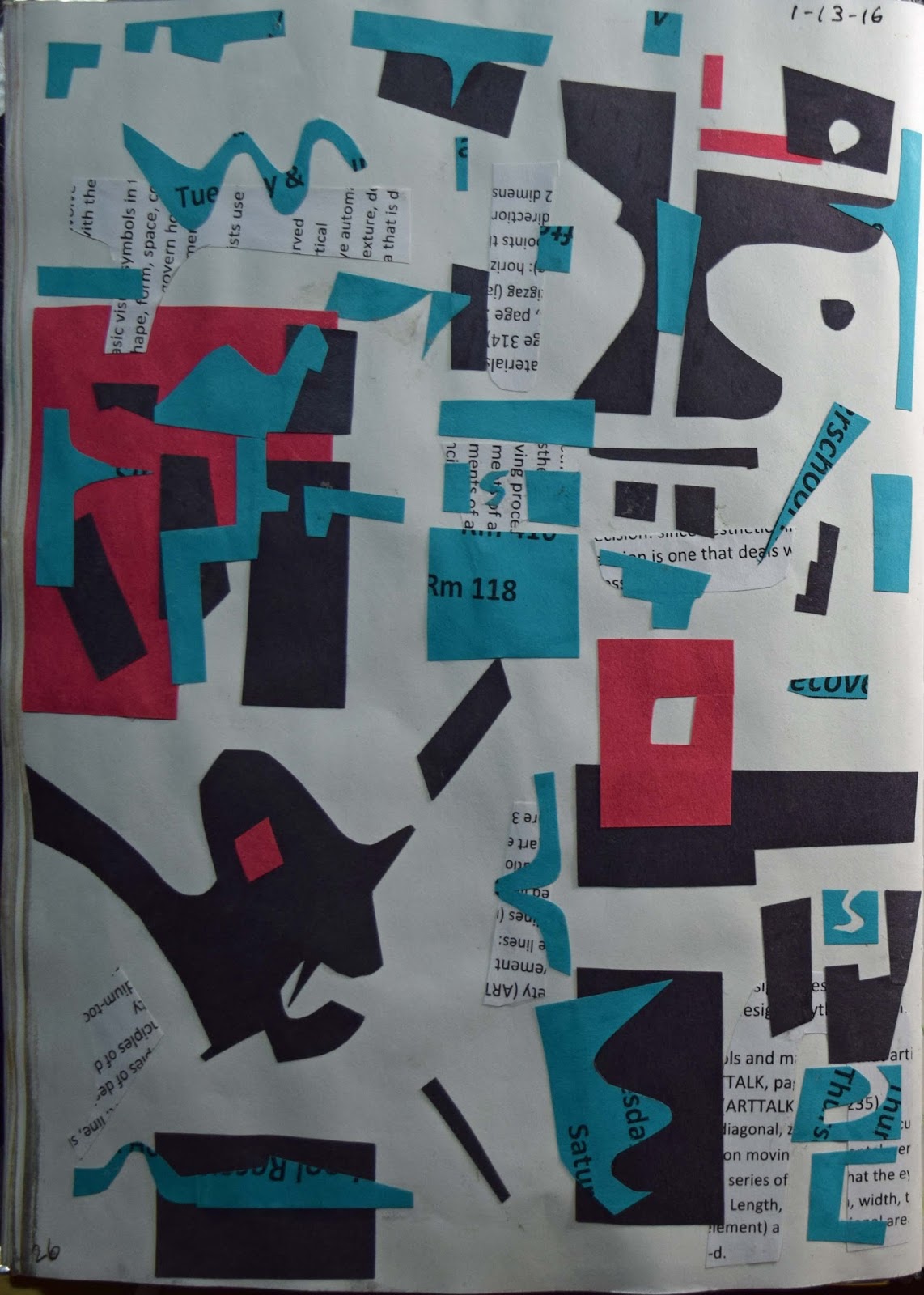
Construction Paper Collage

Well, what can I say.

I like making simple cut paper collage. Sometimes I limit myself to certain proportions of each color then force myself to use every bit of each color.  It helps me to focus on relationships between simple shapes and other shapes, the ever changing empty spaces newly created while arranging and rearranging (figure to ground relationship), each color, and just composition in general.

The other fun thing I like to do is interpret shapes. I see the following: a worm or a razor blade, a one-toothed witch, a bird perched on a branch, the side view of a horse's head, etc.

Mostly, making a simple collage just helps to relax me and relieve stress.  When my arrangement is complete, I just take a photo of it with my phone to use as a reference when I glue each piece down with regular school glue (Elmer's).

Big New Sketchbook, page 26. Collage. Steve Franklin, 2016.
Thanks for viewing, and have a wonderful evening!
-Steve

Tuesday, February 23, 2016

Me Again

Hi.
Here I started with the purple background then started a self portrait with airbrush.  I quickly realized that I needed to clean the airbrush, and the portrait was not coming out as planned.  Since I certainly not up to the task of breaking down then cleaning my airbrush, I decided to try out the Molotow acrylic paint markers to finish the portrait. It worked out okay.

I have the Molotow marker colors in the 2mm size: signal black, traffic red, currant, cool gray pastel, true blue, signal white, hazelnut brown, neon pink, grasshopper, zinc yellow, [ocher] brown light, shock blue middle, DARE orange, neon yellow fluorescent, and KA077 green. I ordered some, but most I bought each day at Michael's art store using a 50% off coupon (nowadays, I can only get 40% off coupons.) I was waiting until I collected a bunch to use them.  I would say that the most useful color I have is the signal white one.  If you can't afford to collect a big set, then I recommend you just get the white one.  I did find that once you lay these down, you should brush over them with a thin coat of clear acrylic because they partly rub off.  Perhaps after drying overnight they form a better bond, but I usually like to play it on the safe side and add the clear coat on top.  I believe your art should be as permanent as you can make it--within reason.
Me. Acrylic on paper, Big New Sketchbook, Steve Franklin, 2015.
Thanks for viewing!
-Steve

Monday, February 22, 2016

Cleopatra, my dog

Hello.
I've been working towards my goal to complete a painting per week.  The last painting that I completed yesterday gave me a hard time.  I had to take several breaks, and finally completed it Sunday eventing. By the time I was finished, I thought: Finally, I can get the struggle is over and out of my life. Now I can move on to something new.

Today, after work, I just feel so tired.  My next panel is primed and ready to start the next image.  I'm disappointed with myself because my body is sore all over, and I don't have the energy to start just yet. Hopefully, I'll be able to start something before the evening is over.

In the meantime, here's a portrait I did of Cleopatra, my dog.
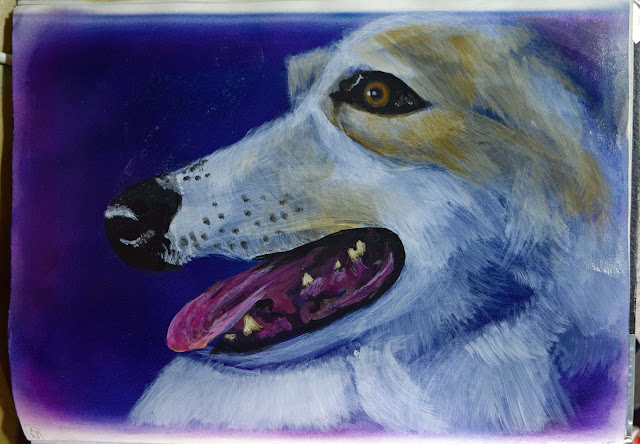
Cleopatra. Big New Sketchbook, page 22. Acrylic. Steve Franklin, 2015.
Starting with a thin coat of gesso then airbrushing the phthalo blue and quinacridone magenta (Golden High Flow Acrylics) for the purple background.  Next, I blocked in most of the image using gesso with a flat 1 inch wide brush. Next, using liquid acrylics, I layered the colors with round and filbert brushes.  All this was sealed with a thin coat of acrylic gloss using a small fan brush. Note: when doing glossy acrylic pages in your sketchbook, you must consider one important thing: the opposing page should not be glossy, or the pages might stick together.  To solve this, I either sketch with pencil or watercolor on the opposite page, or use matte medium followed by a layer of beeswax on the surface of the page to avoid having to peel the pages apart.

Thanks for viewing and have a great evening!

-Steve

Monday, February 15, 2016

Consumption?

Hi.
I don't know why, but I guess at the time I was thinking about consumption while I was doing this page. It seems I was using watercolor, ink pen, acrylic markers,  and a white Gelly Roll pen to complete this page. For some reason, this reminds me that the other day, while using pen and ink and decided to try this: I made different bold watercolor washes and dipped the pen nib into them to see if it works--and it does! I thought: "Now, why didn't I think of that before?"

Thanks for viewing, and have a wonderful day!

Steve
New Big Sketchbook, page 18. Steve Franklin, 2015.

Sunday, February 14, 2016

Random Nose Page

Hi.
Here is a page filled with noses, drawn from direct observation. There are so many noses out there. Have you ever thought of filling a page with just noses?  I've seen my share of pages filled with eyes and lips before.  These are all sketched with a mechanical pencil.  I usually prefer to sketch with either a colored pencil, or a drawing pencil, but at the time, I wanted to just use a mechanical pencil.  It's a 9mm lead pencil.  I prefer to use the 09mm, if I'm going to sketch, because I tend to break the 05's.
i
Big New Sketchbook, page 17. Steve Franklin, 2015.
Thanks for viewing. I appreciate you.
-Steve

Saturday, February 13, 2016

Glazing Color Squares

Hello.  I've been working on paintings lately, and it takes up a lot of my spare time.  In fact, painting takes up most of my spare time.  Here's a page that show my love for color.  In the past, I've done paintings of just squares of color.  Whenever I have a color squares painting on the wall in front of my bed, or a comfortable couch, I can spend time relaxing, just viewing the different squares of color and the relationship between each.

How did I make this page? After adding a thin coat of acrylic gesso to the page, I began the structure with a square stamp which I filled the page with its marks using a red ink pad.  Next, I simply made colored glazes by mixing Golden Acrylic Glazing Liquid with drops of Golden Liquid Acrylic. I make just enough of each glaze to fill a square or two.  Some of the squares are glazed once with a single color. Others are glazed with two or three layers of different colors.  I always enjoy this.  Try it yourself. It's easer to make a glaze with a transparent color.  Most artist colors show the transparency rating on the bottle, or you can research this online. Did you know that there is a transparent white? Well, compared with titanium white, zinc white is transparent.  I did not use zinc white on this page, though.  I usually like to use zinc white when doing portraits. What's your favorite color?
Big New Sketchbook, page 16. Steve Franklin, 2015
I hope you enjoyed this page.  Thanks for viewing, and take care!

-Steve